
- For PC
- For MAC
- For Linux
- OS: Windows 10 (64 bit)
- Processor: Dual-Core 2.2 GHz
- Memory: 4GB
- Video Card: DirectX 11 level video card: AMD Radeon 77XX / NVIDIA GeForce GTX 660. The minimum supported resolution for the game is 720p.
- Network: Broadband Internet connection
- Hard Drive: 23.1 GB (Minimal client)
- OS: Windows 10/11 (64 bit)
- Processor: Intel Core i5 or Ryzen 5 3600 and better
- Memory: 16 GB and more
- Video Card: DirectX 11 level video card or higher and drivers: Nvidia GeForce 1060 and higher, Radeon RX 570 and higher
- Network: Broadband Internet connection
- Hard Drive: 75.9 GB (Full client)
- OS: Mac OS Big Sur 11.0 or newer
- Processor: Core i5, minimum 2.2GHz (Intel Xeon is not supported)
- Memory: 6 GB
- Video Card: Intel Iris Pro 5200 (Mac), or analog from AMD/Nvidia for Mac. Minimum supported resolution for the game is 720p with Metal support.
- Network: Broadband Internet connection
- Hard Drive: 22.1 GB (Minimal client)
- OS: Mac OS Big Sur 11.0 or newer
- Processor: Core i7 (Intel Xeon is not supported)
- Memory: 8 GB
- Video Card: Radeon Vega II or higher with Metal support.
- Network: Broadband Internet connection
- Hard Drive: 62.2 GB (Full client)
- OS: Most modern 64bit Linux distributions
- Processor: Dual-Core 2.4 GHz
- Memory: 4 GB
- Video Card: NVIDIA 660 with latest proprietary drivers (not older than 6 months) / similar AMD with latest proprietary drivers (not older than 6 months; the minimum supported resolution for the game is 720p) with Vulkan support.
- Network: Broadband Internet connection
- Hard Drive: 22.1 GB (Minimal client)
- OS: Ubuntu 20.04 64bit
- Processor: Intel Core i7
- Memory: 16 GB
- Video Card: NVIDIA 1060 with latest proprietary drivers (not older than 6 months) / similar AMD (Radeon RX 570) with latest proprietary drivers (not older than 6 months) with Vulkan support.
- Network: Broadband Internet connection
- Hard Drive: 62.2 GB (Full client)
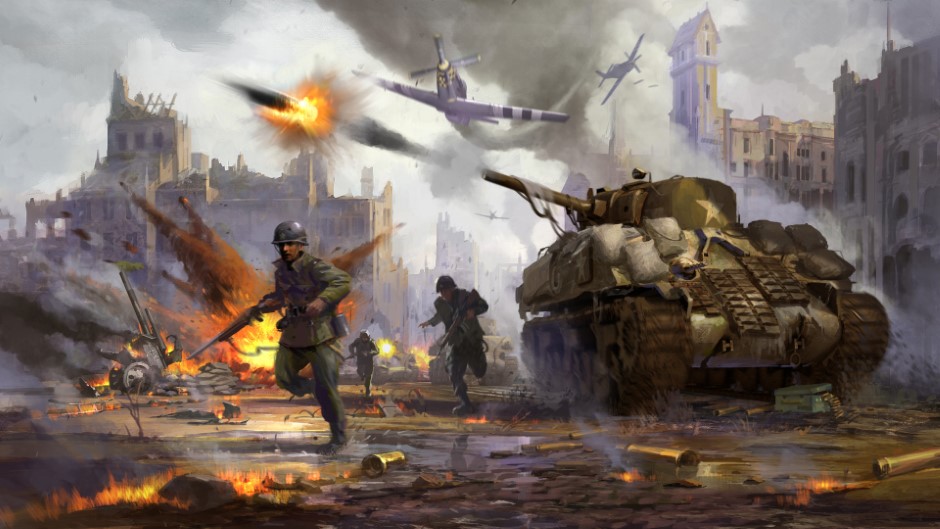
This month’s Pages of History will take you to the heart of events that took place in different theaters of war. From the Netherlands to East Prussia, the Philippines to Guadalcanal: use vehicles that represent these historical battles and win prizes!
From October 1st until October 31st, you will be able to participate in 8 tasks consecutively. Completing each task will grant you a trophy with a reward, completing all of the tasks will earn you a unique player icon!
Léo Major is the only Canadian to receive the Distinguished Conduct Medal for service in multiple wars. He participated in the Normandy Landings and lost his left eye in the Battle of Caen, but insisted on remaining in the line of duty. During the Battle of the Scheldt, he single-handedly captured 93 German soldiers. Major received his first Distinguished Conduct Medal in 1945 for single-handedly liberating the Dutch city of Zwolle. His overnight actions forced German forces to retreat, prompting the Allies to cancel a planned artillery bombardment on the city. He received his second medal six years later for capturing strategic hills in the Korean War.
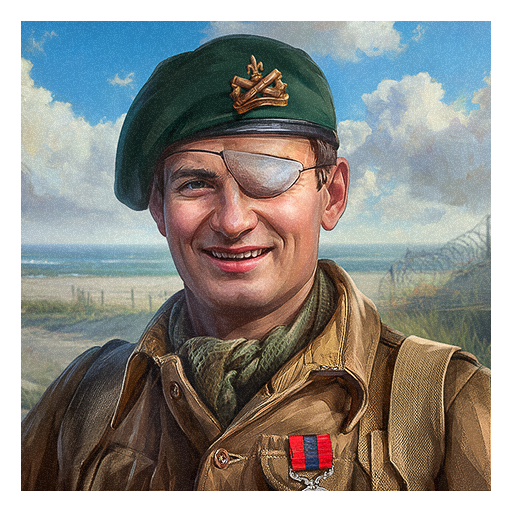
You can immediately purchase this profile icon for Golden Eagles until without completing tasks. To find it, go to your Nickname → Achievements → Pages of History.
Trophy reward for each task
Completing each individual task will give you a trophy with one of the following rewards:
- 20-50% RP booster for 3-10 battles;
- 20-50% SL booster for 3-10 battles;
- 3-5 universal backups;
- Premium account for 1 day;
- A random ground vehicle camouflage (out of those that are currently obtainable with achievements or purchasable with Golden Eagles).
Other terms
- Tasks are available from 11:00 GMT until 11:30 GMT on the final day of each task.
- Tasks can be completed in random battles except for “Assault” mode.
You can read a detailed description of which task is for which day and your overall progress by going to your Nickname → Achievements → Pages of History.
Calendar
October 1st — October 4th
The Allies captured Antwerp on September 4th 1944, but access to the port was blocked by German forces on the banks of the Scheldt. So on October 2nd, an operation began to open the port of Antwerp for supply lines to the front. Canadian troops participated primarily in the operation. Within a month by early November they had achieved their objectives.
October 5th — October 8th
On October 6th 1943, near Vella Lavella Island (Solomon Islands), Japanese naval forces covering the evacuation of infantry from the island engaged the Allies. Both sides lost a destroyer, but during the battle, Japan was able to successfully complete the evacuation.
October 9th — October 12th
On October 12th 1943, the Red Army launched an offensive near the city of Orsha in Belarus. The Red Army failed to remove the Germans from their fortifications, suffering significant losses and only making limited progress. Orsha remained in German hands until the following summer.
October 13th — October 17th
On October 16th 1944, after an artillery barrage, Soviet troops launched an offensive in East Prussia from the Neman River along narrow clearings and marshy forests. On October 22nd they captured Gumbinnen, but lost it two days later to a German counterattack. At the cost of heavy losses, the USSR advanced 80 kilometers across East Prussia, but near Königsberg, the front line remained virtually unchanged.
October 17th — October 20th
The first American landings took place in Leyte Gulf in the Philippines on October 17th 1944. Japanese forces paid little attention to this, but by October 20th, a large-scale American landing on various islands followed. The Allies inflicted a crushing defeat on Japan both on land and at sea, paving the way for the liberation of the Philippines.
October 20th — October 23rd
By the end of the summer of 1942, the Axis offensive in North Africa had been halted, and Marshal Rommel’s subordinates went on the defensive. On the night of October 23rd–24th, Allied forces went on the offensive, and by early November they had broken through the German and Italian defenses. This was a decisive battle of the North African theater of operations, after which the strategic initiative completely passed to the Allies.
October 23rd — October 27th
In early August 1944, as part of the first American landing on Guadalcanal, an airfield under construction was captured. It was named after Lofton Henderson, a U.S. Marine Corps commander killed in the Battle of Midway. From October 23rd-26th, the Japanese attempted to recapture the airfield with a surprise ground attack supported by air and naval support. Several dozen Americans and between two and three thousand Japanese were killed in the battle. After this defeat, Japan made no further major offensive attempts on Guadalcanal.
October 28th – October 31st
After the liberation of Western Romania and the capture of Bucharest, the Soviet command was tasked with defeating Axis forces in Hungary and reaching the Austrian border. On October 29th 1944, the Tisza offensive began. On November 4th, Soviet forces reached the outskirts of Budapest, but the assault lasted almost the entire winter. The remaining Wehrmacht forces in the city only capitulated on February 13th.
Comments (10)
Comments will be premoderatedGlad to see a Canadian hero. Might we see a Belgian one someday ? Selys Longchamp who made an aerial assault on the Gestapo building in Brussels ?
The article says, "In early August 1944, as part of the first American landing on Guadalcanal..." in the section about the Battle of Henderson Field. That battle, along with the American landing, took place in 1942.
thought for a moment its going to be moshe dayan
Léo Major refused his 1st DCM because Montgomery, that he considers incompetent, was supposed to deliver it. He receive his second in Korea. The USA 3rd Infantry Division (10000 men), the "Fire Brigade", lost Hill 355 to the Chinese. Léo Major took it back and held it for 3 days before being relieved. He did it with 18 Royal 22e Régiment volunteers and the help of the US artillery. 19 men faced and held the seven 190e & 191e Chinese Division counterattacks (14000 men) not loosing a single one!
Sgt. Pepper
Even more importantly — will we ever see Antoine de Saint-Exupéry, the legendary French writer and WWII aviator, represented in game alongside a proper P-38 in the French tree?
Or Closterman...
Nishizawa_Hime, "Sadly" Saint-Exupéry only flown unarmed / recon planes with the Bloch MB.174 and F-5 (recon version of the P-38G). I think, they'll be hard to add to the game, unless Gaijin adds the spotting mechanics for recon planes !!!
The inspiration for all single-player FPS games
I wondered if it was Adrian Carton de Wiart.
Submit a complaint