
- For PC
- For MAC
- For Linux
- OS: Windows 10 (64 bit)
- Processor: Dual-Core 2.2 GHz
- Memory: 4GB
- Video Card: DirectX 11 level video card: AMD Radeon 77XX / NVIDIA GeForce GTX 660. The minimum supported resolution for the game is 720p.
- Network: Broadband Internet connection
- Hard Drive: 23.1 GB (Minimal client)
- OS: Windows 10/11 (64 bit)
- Processor: Intel Core i5 or Ryzen 5 3600 and better
- Memory: 16 GB and more
- Video Card: DirectX 11 level video card or higher and drivers: Nvidia GeForce 1060 and higher, Radeon RX 570 and higher
- Network: Broadband Internet connection
- Hard Drive: 75.9 GB (Full client)
- OS: Mac OS Big Sur 11.0 or newer
- Processor: Core i5, minimum 2.2GHz (Intel Xeon is not supported)
- Memory: 6 GB
- Video Card: Intel Iris Pro 5200 (Mac), or analog from AMD/Nvidia for Mac. Minimum supported resolution for the game is 720p with Metal support.
- Network: Broadband Internet connection
- Hard Drive: 22.1 GB (Minimal client)
- OS: Mac OS Big Sur 11.0 or newer
- Processor: Core i7 (Intel Xeon is not supported)
- Memory: 8 GB
- Video Card: Radeon Vega II or higher with Metal support.
- Network: Broadband Internet connection
- Hard Drive: 62.2 GB (Full client)
- OS: Most modern 64bit Linux distributions
- Processor: Dual-Core 2.4 GHz
- Memory: 4 GB
- Video Card: NVIDIA 660 with latest proprietary drivers (not older than 6 months) / similar AMD with latest proprietary drivers (not older than 6 months; the minimum supported resolution for the game is 720p) with Vulkan support.
- Network: Broadband Internet connection
- Hard Drive: 22.1 GB (Minimal client)
- OS: Ubuntu 20.04 64bit
- Processor: Intel Core i7
- Memory: 16 GB
- Video Card: NVIDIA 1060 with latest proprietary drivers (not older than 6 months) / similar AMD (Radeon RX 570) with latest proprietary drivers (not older than 6 months) with Vulkan support.
- Network: Broadband Internet connection
- Hard Drive: 62.2 GB (Full client)
You may remember that we mentioned bomber damage model changes and increased survivability in the latest Community Update post. Well today we’re ready to share some details about the new damage model for bombers that we’re preparing for in the next major update!
The problem and our findings
When flying bombers, you’ve probably noticed that in some cases, a single hit from an enemy could lead to fatal consequences. The survivability of bombers has long been one of the most discussed topics within the community. We’ve been closely monitoring your feedback while simultaneously gathering our own data on the subject. Over the course of several months, we systematized documentation detailing the results of tests involving various types of ammunition against different aircraft components and structural elements, analyzing how the fuselage, wings, engines and wing spars react to impacts from shells, shrapnel, bullets and missiles. Overall it was quite an undertaking, and we’re now ready to present the initial results.
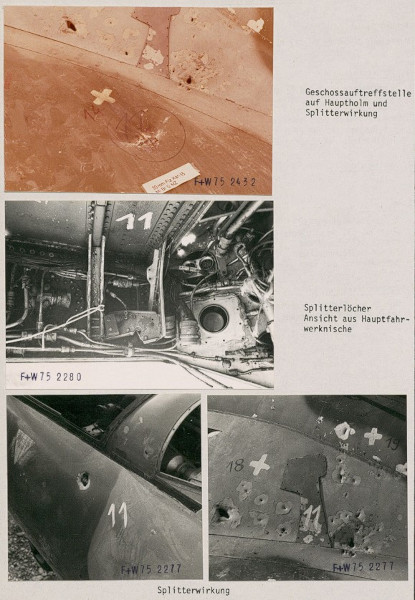
Impact point and shrapnel from a 30 mm HE round
Source: SHE Beschussversuche (Flugzeug - Flugzeug), Bericht über Kanonenschiessen mit Mirage und Hunter auf Pzj G 13, Hongrin 23./24.9.75, Swiss Federal Archives, E4#1000/781#6*, ref. 2.1, BG vom 23.12.1908 betr. die Organisation des EDI, 1908–1909
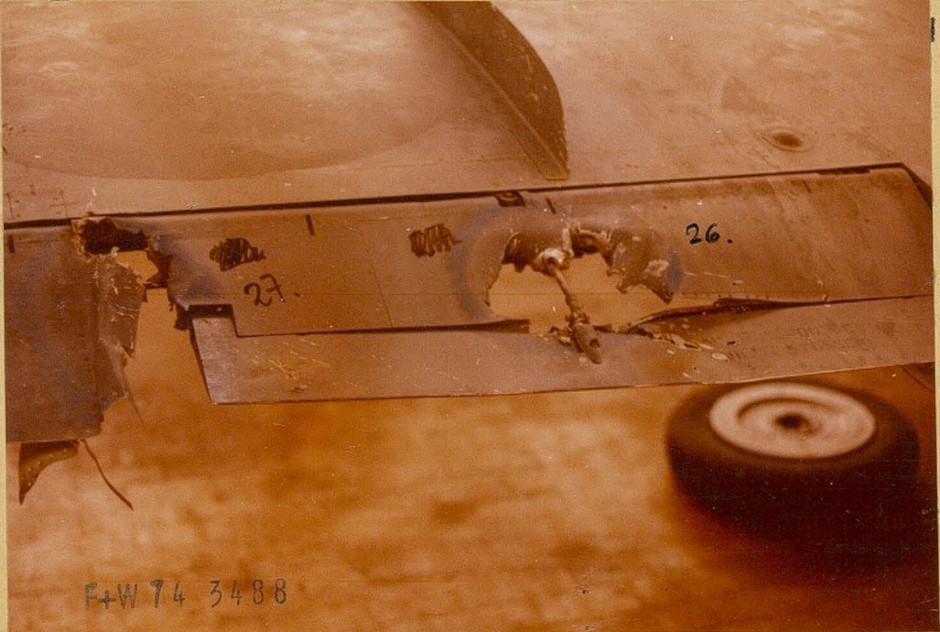
Damage to the flaps from 20 mm rounds
Source: SHE Beschussversuche (Flugzeug - Flugzeug), Bericht über Kanonenschiessen mit Mirage und Hunter auf Pzj G 13, Hongrin 23./24.9.75, Swiss Federal Archives, E4#1000/781#6*, ref. 2.1, BG vom 23.12.1908 betr. die Organisation des EDI, 1908–1909
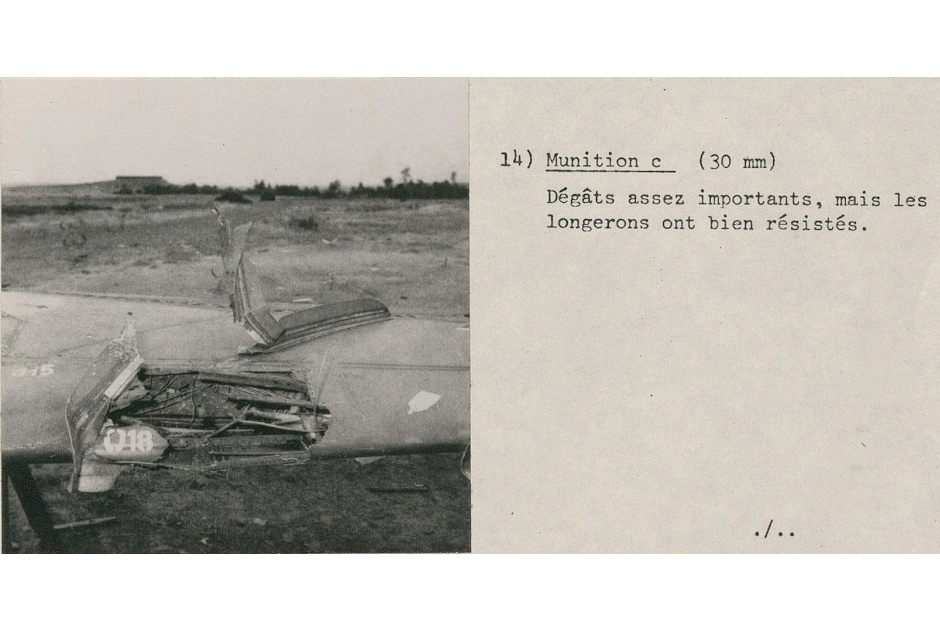
Damage to longerons
Source: SHE Beschussversuche (Flugzeug - Flugzeug), PROTOCOLE No. 35, Swiss Federal Archives, E4#1000/781#6*, ref. 2.1, BG vom 23.12.1908 betr. die Organisation des EDI, 1908–1909
This is the conclusion that we’ve come to: in reality, an aircraft’s structural elements, such as spars, the center wing section, and ribs sustain damage extremely rarely. Small fragments weighing around three grams are simply incapable of compromising the structural integrity of the airframe. Blast damage from external explosions also proved negligible; even high blast-wave pressure on the wing rarely resulted in critical damage.
More than 60% of losses in actual combat were caused by fires in the fuel and oil systems rather than structural failure. Many instances of damage did not result in the immediate loss of the aircraft, but merely forced the pilot to abort the mission and make an emergency landing within 30 minutes, or even up to two hours. Survivability depends heavily on the thickness and material of the skin. Plus, the largest bombers feature a wing box structure in which the upper and lower skin panels also serve as load-bearing elements; these panels are significantly thicker than the skin of conventional spar-based wings, reaching thicknesses of tens of millimeters in certain parts of the structure. Generally speaking, with increase in aircraft speed, the structural integrity and the thickness of the skin also increases. This will also be reflected in the game for aircraft of different time periods.
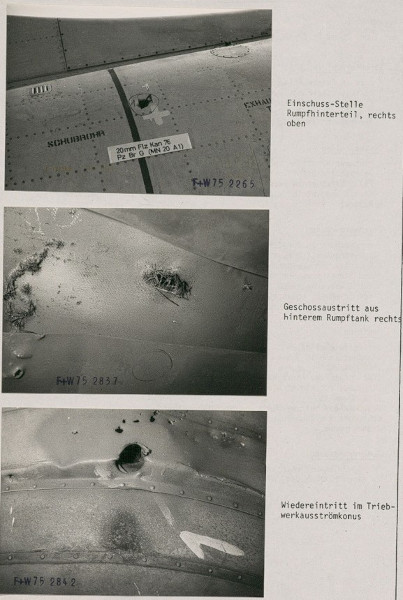
Damage from 20 mm AP rounds
Source: SHE Beschussversuche (Flugzeug - Flugzeug), Bericht über Kanonenschiessen mit Mirage und Hunter auf Pzj G 13, Hongrin 23./24.9.75, Swiss Federal Archives, E4#1000/781#6*, ref. 2.1, BG vom 23.12.1908 betr. die Organisation des EDI, 1908–1909
Conclusion from our research
Based on our research, we’ve completely overhauled the damage model for bombers. We’ve fixed accumulated errors, adjusted damage accumulation parameters, recalculated hit zones, and updated settings for wing spars, tail assemblies, fuselages, and engines. We’ve adopted a flexible approach: for piston-engined aircraft, we created distinct configurations for inline and radial engines, as well as for varying engine counts ranging from two to six. We also separately tuned jet bombers, which require a different damage calculation logic. Alongside the bombers, we updated the damage models for other aircraft classes derived from bomber airframes, specifically the A-26 Invader and Pe-3 families, the Su-8, Tu-1, and TIS-MA attack aircraft, and the Ju 388 J interceptor.
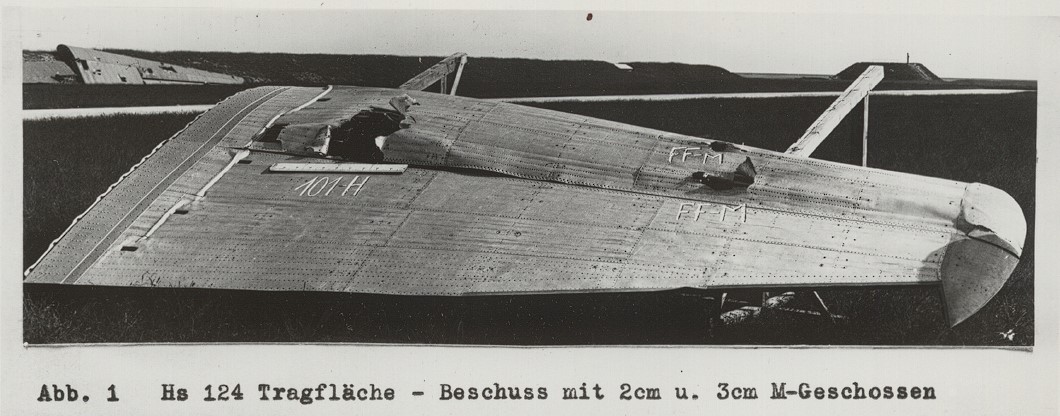
Damage from 20 mm and 30 mm high-explosive incendiary rounds (minengeschoß)
Source: BArch, RL_3_1900 Passiven Flugzeug-Schutz. Vorträge. Bd. 1
The bottom line is, even though we’ve only just begun implementing our findings regarding the survivability of aircraft components against various types of projectiles, bombers have become noticeably more resilient. The enemy can still shoot you down of course, but doing so now requires greater effort and more precise aim. Shearing off wings is now significantly harder, instead you should aim accurately at fuel tanks, engines and the crew itself, which is precisely the targets that pilots were advised to aim for in real life. The type of shell or bullet now play a more crucial role as well.
We’ll continue to refine and improve the damage model, rest assured we’re just getting started and have a long road ahead. But we believe we’ll see more bombers taking to the skies of War Thunder!


Comments (150)
Comments will be premoderatedNow can we increase the gunners' effective range from 200m to at least 500m?
What is about the missing aircraft that are based on a bomber frame? (e.g. Do 217J&N, Ju 88 C) Will the list be expanded?
I think the Italy attack aircraft p108a(series2) should also have a improved damage model, because it is the same aircraft as other p108 bombers, the only difference is that it uses a cannon instead of bombs. I hope developers can take my advice into consideration. Thanks.
Will details be added such as the number 3 wing of B-17s also controlling hydraulics (i only recently learned each engine powered various subsystems) and therefore landing gear lowering? I just finished a great book on tactics used by Luftwaffe pilots and the number 3 engine was the first target.
This is very nice. Finally it will be beneficial to use the MK-108 on the K4. Not for cool montages, but for it's real purpose, bomber hunting. The 20mm was the best option for every situation in years, finally this shakes things up a bit.
Glad to see bombers getting an update. I love flying these big girls but anything with a cannon or a heavy machine gun kills you crazy quick.
Bless the holy snail. Maybe I can start spading my bombers soon then. Great work 👍👏
Will you guys also be upping the fire range and fire rate if AI gunners?
Since you are talking about realism. Can you remove trees around airfield? To be specific, trees at the front of airfield, because with fully loaded bomber are those extra few meters important.
The individual tanks should come with a cuboid registration box for representing the fuel vapor. The cuboid's origin pos should be off-center, it should extend further aft when enlarged. The incendiary sparks should be detected inside the vape to trigger a fire chance. The size of the box should be directly tied to the flow rate of the fuel. The fuel leak rate should be too much for the current game. There should be a mode with 5 times FCR with 1/3 performance penalty.
Submit a complaint