
- For PC
- For MAC
- For Linux
- OS: Windows 10 (64 bit)
- Processor: Dual-Core 2.2 GHz
- Memory: 4GB
- Video Card: DirectX 11 level video card: AMD Radeon 77XX / NVIDIA GeForce GTX 660. The minimum supported resolution for the game is 720p.
- Network: Broadband Internet connection
- Hard Drive: 23.1 GB (Minimal client)
- OS: Windows 10/11 (64 bit)
- Processor: Intel Core i5 or Ryzen 5 3600 and better
- Memory: 16 GB and more
- Video Card: DirectX 11 level video card or higher and drivers: Nvidia GeForce 1060 and higher, Radeon RX 570 and higher
- Network: Broadband Internet connection
- Hard Drive: 75.9 GB (Full client)
- OS: Mac OS Big Sur 11.0 or newer
- Processor: Core i5, minimum 2.2GHz (Intel Xeon is not supported)
- Memory: 6 GB
- Video Card: Intel Iris Pro 5200 (Mac), or analog from AMD/Nvidia for Mac. Minimum supported resolution for the game is 720p with Metal support.
- Network: Broadband Internet connection
- Hard Drive: 22.1 GB (Minimal client)
- OS: Mac OS Big Sur 11.0 or newer
- Processor: Core i7 (Intel Xeon is not supported)
- Memory: 8 GB
- Video Card: Radeon Vega II or higher with Metal support.
- Network: Broadband Internet connection
- Hard Drive: 62.2 GB (Full client)
- OS: Most modern 64bit Linux distributions
- Processor: Dual-Core 2.4 GHz
- Memory: 4 GB
- Video Card: NVIDIA 660 with latest proprietary drivers (not older than 6 months) / similar AMD with latest proprietary drivers (not older than 6 months; the minimum supported resolution for the game is 720p) with Vulkan support.
- Network: Broadband Internet connection
- Hard Drive: 22.1 GB (Minimal client)
- OS: Ubuntu 20.04 64bit
- Processor: Intel Core i7
- Memory: 16 GB
- Video Card: NVIDIA 1060 with latest proprietary drivers (not older than 6 months) / similar AMD (Radeon RX 570) with latest proprietary drivers (not older than 6 months) with Vulkan support.
- Network: Broadband Internet connection
- Hard Drive: 62.2 GB (Full client)
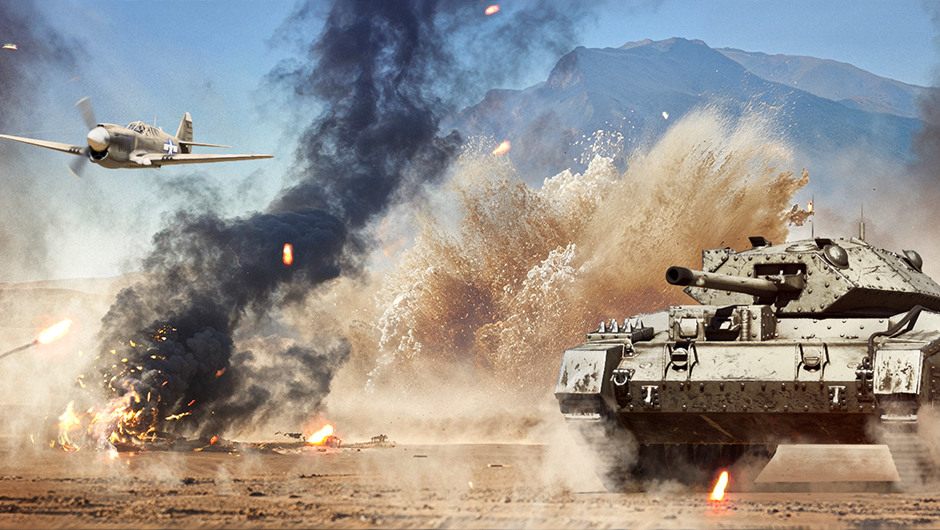
In Pages of History this month, you will find yourself at the center of events that took place in various theaters of war. From Austria and Iraq, Tunisia and Cambodia: participate in battles while using vehicles linked to these historic battles and get some prizes!
, you will be able to participate in 8 tasks consecutively. Completing each task will grant you a trophy with a reward, completing all of the tasks will earn you a unique profile background!

Operation Vulcan was the penultimate operation in the entire North African theater of war. The United States, Great Britain, and France, working together, breached the defenses of Germany and Italy. They opened the road to the capital of Tunisia, and prepared the bridgehead for the final offensive that led to the surrender of the Axis forces in the region in May 1943.
You can purchase this profile background for Golden Eagles without completing tasks. To find it, go to your Nickname → Achievements → Pages of History.
Trophy reward for each task
Completing each individual task will give you a trophy with one of the following rewards:
- 20-50% RP booster for 3-10 battles;
- 20-50% SL booster for 3-10 battles;
- 3-5 universal backups;
- Premium account for 1 day;
- A random ground vehicle camouflage (out of those that can currently be unlocked or purchased with Golden Eagles).
Other terms
- Tasks are available from 11:00 GMT until 11:30 GMT on the final day of each task.
- Tasks can be completed in random battles except for “Assault” mode.
You can read a detailed description of which task is for which day and your overall progress by going to your Nickname → Achievements → Pages of History.
Calendar
April 1st — April 4th
The Karbala Gorge, between the Euphrates River and Lake Milh in central Iraq, was a bottleneck on the road to Baghdad. In early April 2003, American troops fought their way through the gorge, routing the Medina Armored Division.
April 5th — April 8th
On April 6th 1945, the Red Army launched an assault on Königsberg, the capital of East Prussia. Königsberg had a multi-layered defense. The fortress was protected by approximately 15 large forts, concrete pillboxes, anti-tank ditches, canals and rivers, and powerful fire positions within the urban area. However, the Soviet forces were well trained and well armed, and the fortress fell on April 9th.
April 9th — April 12th
On April 9th 1940, the Wehrmacht launched an operation to seize Denmark and Norway, disguised as exercises on the Weser River. Denmark capitulated immediately, while Norway fought back, fiercely fighting for its territory for two months. This was the first major German combined naval, air, and land operation of a surprise nature. In response, Great Britain occupied Iceland and the Faroe Islands to prevent their capture by Germany.
April 13th — April 16th
Shortly after the capture of Vienna, on April 15th 1945, one of the final offensive operations of the Second World War in Europe began on Austrian territory. Soviet and Bulgarian forces intended to defeat the remaining Axis forces in Austria, capture Graz, and reach the line of contact with US forces. The operation was successfully completed by May 8th-9th, but even after Germany’s surrender, the Allies had to suppress pockets of resistance from groups that refused to lay down their arms.
April 17th — April 20th
In mid-April 1945, the British Army launched an offensive on Hamburg, the largest port in northern Germany. After capturing Bremen on April 26th, it quickly encircled Hamburg, and on May 3rd, the city capitulated without street fighting. On May 4th, Field Marshal Montgomery accepted the surrender of all German forces in Denmark, the Netherlands, and northwest Germany.
April 20th — April 23rd
On April 22nd 1943, after a powerful artillery barrage, Allied forces launched an offensive towards the capital of Tunisia. They succeeded in breaking through Axis defensive positions, destroying a large number of enemy equipment. A key position taken during the offensive was Longstop Hill, a 270-meter vantage point that served as the primary obstacle on the way to the capital.
April 24th — April 27th
On April 24th 1982, the IRGC attacked Iraqi forces along the entire front in Khuzestan province and soon pushed them back to Khorramshahr, which was liberated on May 24th. Following this defeat, Iraq offered a ceasefire, but Iran refused and shifted the fighting into enemy territory.
April 27th — April 30th
On April 29th 1970, South Vietnamese and US forces invaded Cambodia with the aim of driving out the Viet Cong. The operation was briefly successful, but it triggered a political crisis in the US and then in Cambodia, where the Khmer Rouge came to power a few years later. North Vietnam, however, reestablished bases and supply routes in Cambodia within six months.


Comments (12)
Comments will be premoderatedCan we get the 2nd may 1945 soviet flag erection on reichstag backround for may pages of history?
No thank you, no more soviet glorification.
HauptmannTinus, Glorification of a historical Image? Dude I dislike the soviets but that is pretty iconic and would make a great profile background for people who like playing russian vehs.
For May, can we get a Soviet profile background?
Nyet
Glad to see more modern battles in this season for a change. It allows to play different vehicles and that's nice. (Kinda getting tired of always playing the same Bf 109, Sherman and T-34, even if they are great). Thanks.
" In early April 2003" Um what?!
What's wrong? Battle of Karbala happened in 2003.
Before ur time lil bro
Please consider doing one for a true Canadian Hero... Léo Major (1921–2008) read about him.
Why do we so rarely see naval heroes in the pages of history?
Hopefully some more modern warfare backgrounds next month, like Korea, Vietnam, or even more recent Middle East conflicts from 1950 onwards.
Submit a complaint