
- For PC
- For MAC
- For Linux
- OS: Windows 10 (64 bit)
- Processor: Dual-Core 2.2 GHz
- Memory: 4GB
- Video Card: DirectX 11 level video card: AMD Radeon 77XX / NVIDIA GeForce GTX 660. The minimum supported resolution for the game is 720p.
- Network: Broadband Internet connection
- Hard Drive: 23.1 GB (Minimal client)
- OS: Windows 10/11 (64 bit)
- Processor: Intel Core i5 or Ryzen 5 3600 and better
- Memory: 16 GB and more
- Video Card: DirectX 11 level video card or higher and drivers: Nvidia GeForce 1060 and higher, Radeon RX 570 and higher
- Network: Broadband Internet connection
- Hard Drive: 75.9 GB (Full client)
- OS: Mac OS Big Sur 11.0 or newer
- Processor: Core i5, minimum 2.2GHz (Intel Xeon is not supported)
- Memory: 6 GB
- Video Card: Intel Iris Pro 5200 (Mac), or analog from AMD/Nvidia for Mac. Minimum supported resolution for the game is 720p with Metal support.
- Network: Broadband Internet connection
- Hard Drive: 22.1 GB (Minimal client)
- OS: Mac OS Big Sur 11.0 or newer
- Processor: Core i7 (Intel Xeon is not supported)
- Memory: 8 GB
- Video Card: Radeon Vega II or higher with Metal support.
- Network: Broadband Internet connection
- Hard Drive: 62.2 GB (Full client)
- OS: Most modern 64bit Linux distributions
- Processor: Dual-Core 2.4 GHz
- Memory: 4 GB
- Video Card: NVIDIA 660 with latest proprietary drivers (not older than 6 months) / similar AMD with latest proprietary drivers (not older than 6 months; the minimum supported resolution for the game is 720p) with Vulkan support.
- Network: Broadband Internet connection
- Hard Drive: 22.1 GB (Minimal client)
- OS: Ubuntu 20.04 64bit
- Processor: Intel Core i7
- Memory: 16 GB
- Video Card: NVIDIA 1060 with latest proprietary drivers (not older than 6 months) / similar AMD (Radeon RX 570) with latest proprietary drivers (not older than 6 months) with Vulkan support.
- Network: Broadband Internet connection
- Hard Drive: 62.2 GB (Full client)
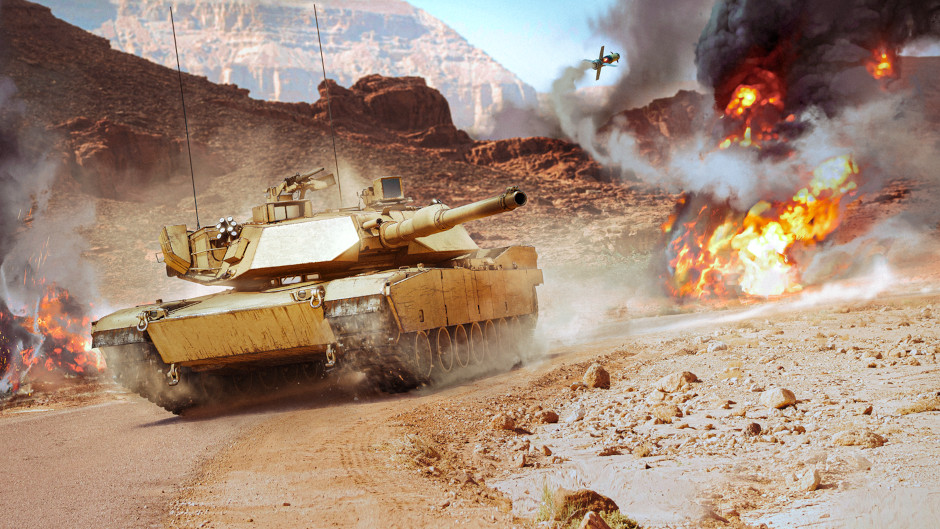
Hi everyone! We’re continuing to refine mechanics related to vehicle mobility. Some of these will significantly alter how vehicles behave, making them more effective in certain situations while less so in others. We’ll introduce these on the dev server so that you can try them out. Other mechanics will improve vehicle performance regardless of the situation, and we plan to release these alongside the Eagle’s Shadow major update. Let’s dive in.
Mechanics Undergoing Testing
The dev server will feature mechanics for the steering systems of tracked vehicles, designed to bring their behavior closer to that of real-world counterparts. These include the double-differential steering mechanism, which we previously tested on a previous dev server, as well as dual transmission and planetary (epicyclic) gear mechanisms.
Double Differential
Let’s start with the theory. In vehicles equipped with a double differential mechanism, a portion of the engine’s power is transmitted to the tracks via the gearbox, while another portion is routed through a differential steering mechanism. The final torque applied to the half axle, which drives a track, is the result of combining the torque delivered through the gearbox with the torque transmitted through the differential mechanism that slows one half axle down while speeding the other one up. This configuration makes it possible to slow down one track while using the “saved” energy to accelerate the other.
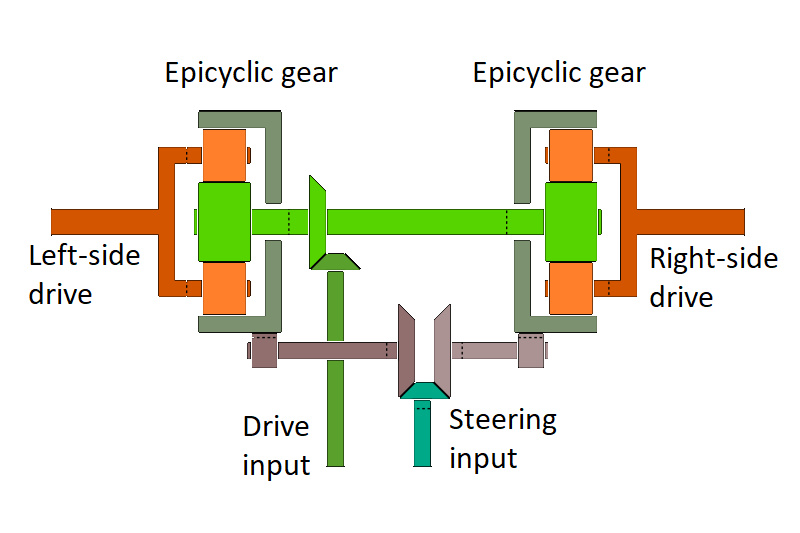
In a double differential mechanism, there is no fundamental difference between turning while in motion and pivoting in place; both maneuvers mechanically function in the same way. When the transmission is in neutral, torque is transmitted solely through the steering mechanism, causing the axles to rotate in opposite directions, which is what enables a vehicle to turn in place. Consequently, for tanks equipped with a double differential steering system, the pivot speed will change with the addition of the new steering mechanic, and for some vehicles, the time required to complete a pivot may increase.
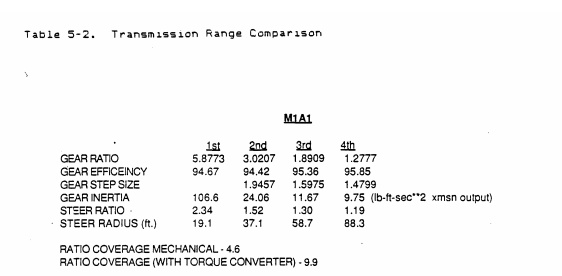
One aspect of this design is that the turning radius is larger than that of vehicles equipped with a side gearbox or planetary steering mechanisms; it depends on the difference in rotational speed between the two axles. However, the maximum rotational speed of the differential is limited, and the maximum rotational speed of the transmission’s output shaft varies depending on the selected gear. As a result, while the maximum absolute difference in axle speeds (in terms of RPM) remains constant, the ratio of these speeds depends on the gear currently engaged. Therefore, the minimum turning radius increases based on the gear in which the vehicle is moving. For instance, in the M1A1 Abrams tank, the calculated turning radius varies according to the gear as follows:
1 - 5.8 m (19.1ft), 2 - 11.3 m (37.1ft), 3 - 17.9 m (58.7ft), 4 - 26.9 m (88.3ft).
For a number of other tanks, the minimum turning radius at maximum gear can reach 30–40 meters, and sometimes even 70 meters. Therefore, tanks equipped with double-differential steering systems achieve a level of speed retention during turns that is unsurpassed among tracked vehicles at the cost of an increased minimum turning radius.
It should be noted that, due to their design, transmissions utilizing a double-differential steering mechanism lack the side clutches that would otherwise allow for the independent braking of a single track. Consequently, the independent braking of a track suggested by some players during the previous dev server session is fundamentally impossible for vehicles with double differential steering mechanisms.
However, following the previous test, we’ve implemented a downshift feature that triggers whenever the brake (or reverse key) is pressed while turning. This allows players to actively reduce their turning radius and gain better control over their vehicle.

You can test this mechanic on the Eagle’s Shadow major update dev server using all variants of the M1 Abrams, TKX, Type 10, and Type 90, as well as the AMX-32 and all vehicles based on the AMX-30 or Leopard 2 platforms (with the exception of the Leopard 2K). The double differential steering mechanic has been intentionally omitted from the Leopard 2K, allowing you to clearly compare its handling against other vehicles in the same family. Please share your feedback with us.
Dual Transmission
For vehicles equipped with dual transmission, such as the entire series of Soviet T series tanks and their derivatives, a fully functional steering mechanism has been implemented. In reality, these vehicles feature a separate gear box for each track; when turning, the transmission for the inner (slower-moving) track shifts into a lower gear, at most one step below the gear engaged for the outer track. This is now replicated in-game! Furthermore, the gear engagement can be partial, for instance, the sixth and seventh gears might effectively operate simultaneously, because the clutches are slipping. This results in a smooth, rather than stepped, turning motion.
However, the turning radius also depends on the ratio between the rotational speeds of the half axles. Consequently, when turning in “short” gears (those where the difference in speed between the gears is minimal) the turning radius can be quite large. For example, on the T-64 and T-72, the turning radius varies based on the selected gear as follows:
1 - 2.79 m, 2 - 6.04 m, 3 - 13.42 m, 4 - 13.93 m, 5 - 10.23 m, 6 - 10.1 m, 7 - 8.76 m.
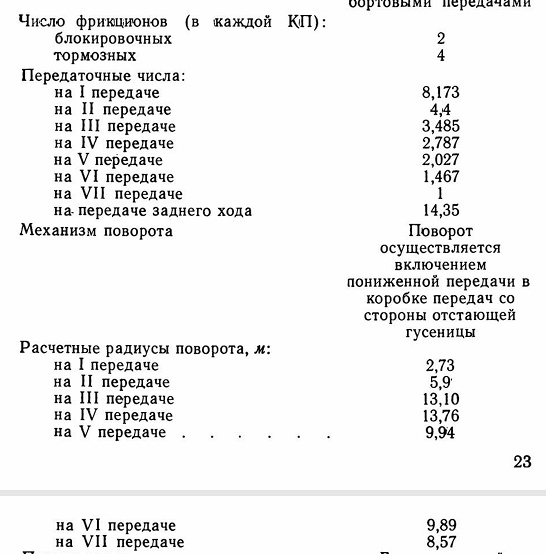
As can be seen, the turning radius in 3rd–4th gears is significantly larger than in 5th–7th gears precisely because of the “short” gears.
In contrast, the T-80’s side gearboxes utilize “long” gears (made possible by the installation of a gas-turbine engine), and the turning radii in the lower gears do not exceed those in the higher gears:
1st — 2.8 m, 2nd — 5.55 m, 3rd — 8.63 m, 4th — 8.86 m.
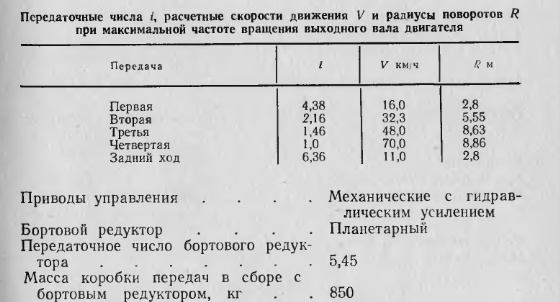
However, it is worth noting that the turning radii specified in technical documentation are often theoretical, calculated solely based on the kinematic ratios of the transmission gears, and may not account for track slippage or the vehicle’s moment of inertia, both of which increase the actual turning radius.
The dual transmission, just like the double differential will have the downshift mechanic in turns which works when you brake. You can test the dual transmissions mechanics in all vehicles from the T series: the T-64, T-72, T-80, and T-90 as well as other vehicles based on these platforms.
Planetary Steering Mechanisms
The third type of steering mechanism involves the use of planetary (epicyclic) steering mechanisms. In reality, this mechanism engages a reduction gear on the inner (slower-moving) side to execute a wide-radius turn, while disengaging the clutch and applying the brake to execute a tight-radius turn. This design lowers speed loss during wide turns while still allowing for rapid, sharper turns, albeit at the cost of speed. In the game, this functions as follows: when initiating a gentle turn by short taps of the turn button or a minor deflection of the controller axis, a reduction gear is engaged on the inner side; conversely, if you attempt to turn while holding the turn key or deflect the controller axis a lot, the mechanism operates in the same way as it does on vehicles equipped only with simple side clutches (such as the T-34). When pivoting, however, the turn will always be conducted around the stopped track.
Unlike dual transmission or double differential steering systems, planetary steering mechanisms allow for independent braking of the left and right tracks, providing greater control. Furthermore, when a reduction gear is engaged, the turning radius remains constant regardless of the selected gear, as the speed ratio between the inner and outer tracks stays the same. However, these mechanisms do not compensate for the loss of speed that occurs during turns.
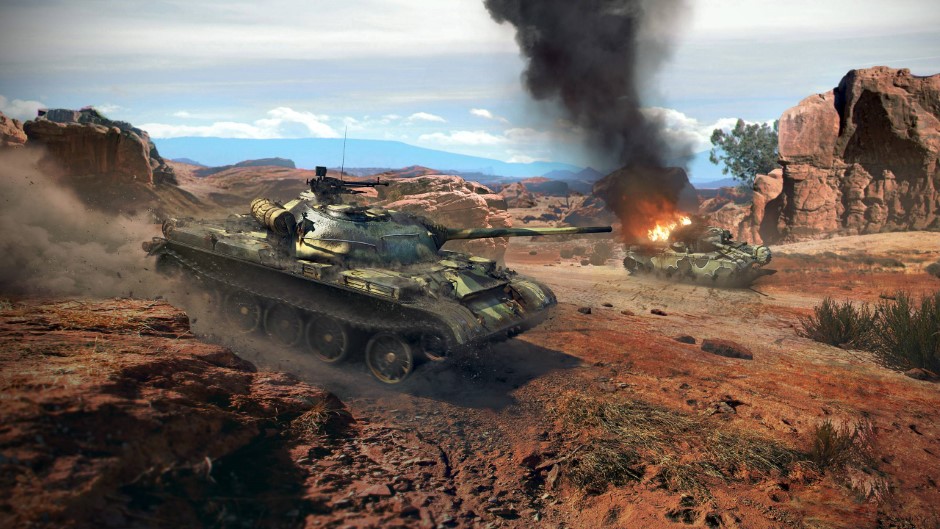
You can test the mechanics of planetary steering systems on a variety of vehicles. A complete list can be found in the preliminary patch notes for the dev server. The T-54 and T-44 serve as excellent examples for comparing vehicles with and without this steering mechanic.
While we plan to test double differential and dual transmission steering systems, they will not be included in this major update. The planetary steering mechanic, however, provided no issues arise, may be added in this update, as it enhances vehicle handling without imposing any trade-offs or drawbacks.
Torque Characteristics of Turboshaft Engines
We are done with the steering mechanisms, let’s get to the changes in engines. To begin, let’s again look at some theory: as you may know, turboshaft engines are fundamentally similar to the jet engines used in aircraft. But turbojet engines use the resulting gas to propel the aircraft forward, while turboshaft engines use the resulting gas to move a separate, free (power) turbine, which then transmits the resulting torque to the tracks.
Unlike piston-based internal combustion engines, turboshaft engines produce immense torque at low rotational speeds (RPM). This happens because the rotational speed of the power turbine shaft is independent of the rotational speed of the gas generator’s turbine shafts, so the gas generator can operate at maximum power output even when the power turbine shaft is stationary or rotating at very low speeds. Under these conditions, torque is at its peak, and as the rotational speed increases, the torque decreases, which you can see on the graphs below.
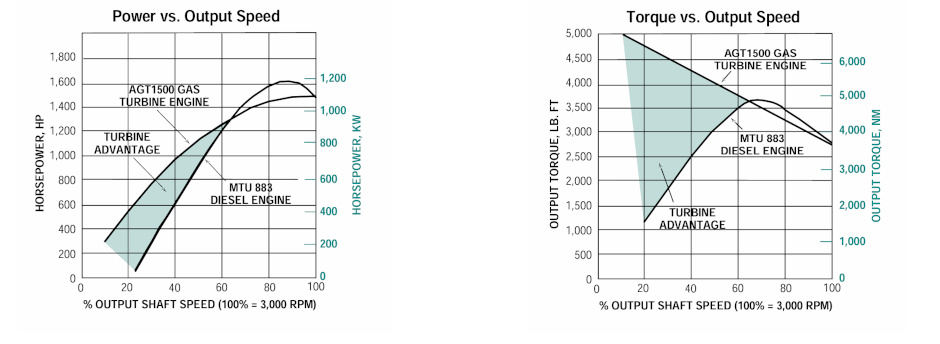
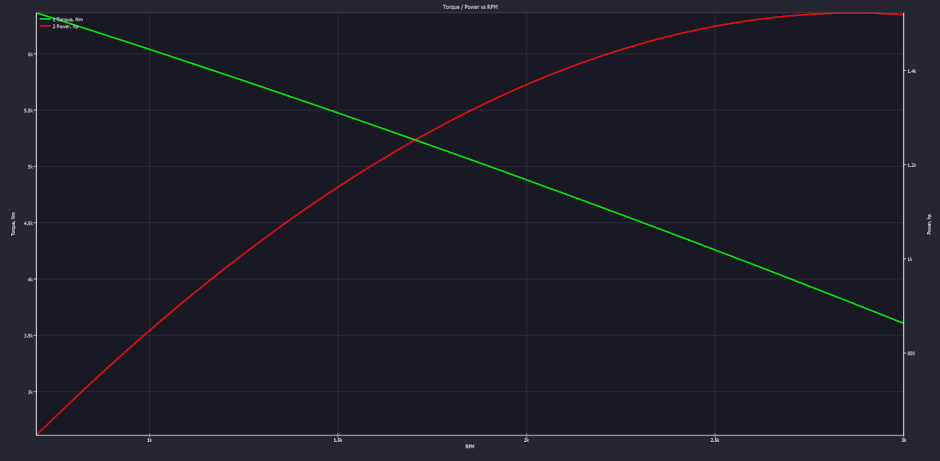
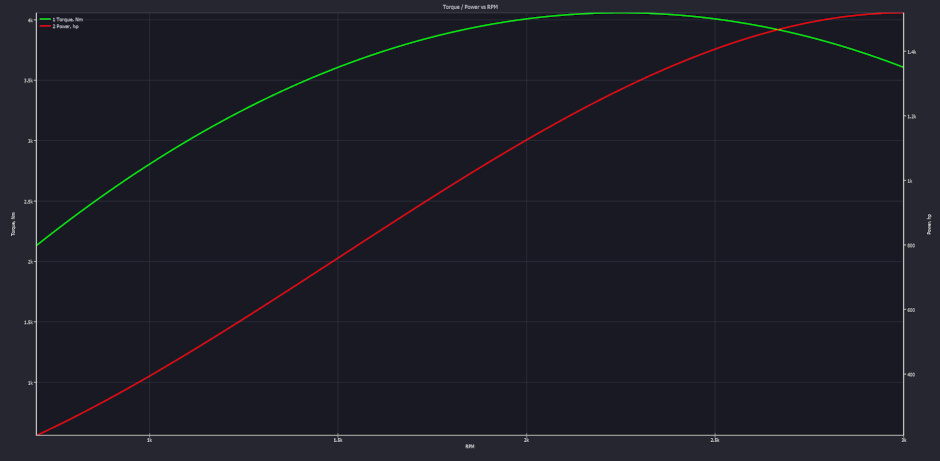
Before/After. The dependence of the torque and output power of AGT1500 on RPM. Green is torque, red is the output power.
This torque-to-RPM ratio allows for the use of transmissions with fewer gears. We have implemented an accurate full throttle performance curve (the dependency of torque on engine RPM) for turboshaft engines. Consequently, we’ll be removing the intermediate gears previously used on turboshaft-powered tanks, as these are gears that were originally implemented to emulate engine and transmission behavior in the absence of a rigid kinematic link between the tracks and the engine or gas generator. Thus, it will affect all tanks with torque converters and turboshaft engines.
Torque converters function in a similar way, increasing torque when the turbine wheel “slips” relative to the pump wheel. However, these are a topic for another time, as we plan to implement the torque converter mechanic in the upcoming updates.
Stay tuned for further details, share you opinion on the new steering mechanics and see you in battle!


Comments (0)
Comments will be premoderatedSubmit a complaint