
- For PC
- For MAC
- For Linux
- OS: Windows 10 (64 bit)
- Processor: Dual-Core 2.2 GHz
- Memory: 4GB
- Video Card: DirectX 11 level video card: AMD Radeon 77XX / NVIDIA GeForce GTX 660. The minimum supported resolution for the game is 720p.
- Network: Broadband Internet connection
- Hard Drive: 23.1 GB (Minimal client)
- OS: Windows 10/11 (64 bit)
- Processor: Intel Core i5 or Ryzen 5 3600 and better
- Memory: 16 GB and more
- Video Card: DirectX 11 level video card or higher and drivers: Nvidia GeForce 1060 and higher, Radeon RX 570 and higher
- Network: Broadband Internet connection
- Hard Drive: 75.9 GB (Full client)
- OS: Mac OS Big Sur 11.0 or newer
- Processor: Core i5, minimum 2.2GHz (Intel Xeon is not supported)
- Memory: 6 GB
- Video Card: Intel Iris Pro 5200 (Mac), or analog from AMD/Nvidia for Mac. Minimum supported resolution for the game is 720p with Metal support.
- Network: Broadband Internet connection
- Hard Drive: 22.1 GB (Minimal client)
- OS: Mac OS Big Sur 11.0 or newer
- Processor: Core i7 (Intel Xeon is not supported)
- Memory: 8 GB
- Video Card: Radeon Vega II or higher with Metal support.
- Network: Broadband Internet connection
- Hard Drive: 62.2 GB (Full client)
- OS: Most modern 64bit Linux distributions
- Processor: Dual-Core 2.4 GHz
- Memory: 4 GB
- Video Card: NVIDIA 660 with latest proprietary drivers (not older than 6 months) / similar AMD with latest proprietary drivers (not older than 6 months; the minimum supported resolution for the game is 720p) with Vulkan support.
- Network: Broadband Internet connection
- Hard Drive: 22.1 GB (Minimal client)
- OS: Ubuntu 20.04 64bit
- Processor: Intel Core i7
- Memory: 16 GB
- Video Card: NVIDIA 1060 with latest proprietary drivers (not older than 6 months) / similar AMD (Radeon RX 570) with latest proprietary drivers (not older than 6 months) with Vulkan support.
- Network: Broadband Internet connection
- Hard Drive: 62.2 GB (Full client)
You may remember that we mentioned bomber damage model changes and increased survivability in the latest Community Update post. Well today we’re ready to share some details about the new damage model for bombers that we’re preparing for in the next major update!
The problem and our findings
When flying bombers, you’ve probably noticed that in some cases, a single hit from an enemy could lead to fatal consequences. The survivability of bombers has long been one of the most discussed topics within the community. We’ve been closely monitoring your feedback while simultaneously gathering our own data on the subject. Over the course of several months, we systematized documentation detailing the results of tests involving various types of ammunition against different aircraft components and structural elements, analyzing how the fuselage, wings, engines and wing spars react to impacts from shells, shrapnel, bullets and missiles. Overall it was quite an undertaking, and we’re now ready to present the initial results.
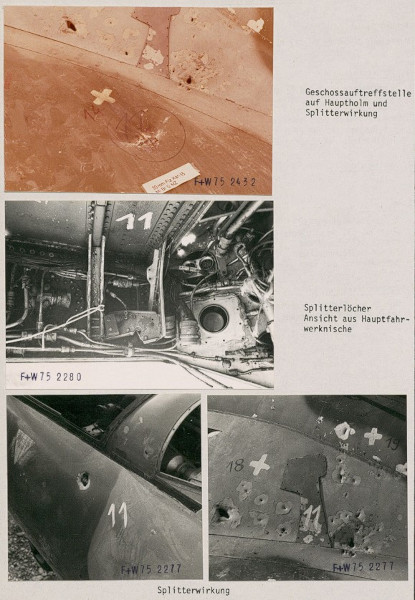
Impact point and shrapnel from a 30 mm HE round
Source: SHE Beschussversuche (Flugzeug - Flugzeug), Bericht über Kanonenschiessen mit Mirage und Hunter auf Pzj G 13, Hongrin 23./24.9.75, Swiss Federal Archives, E4#1000/781#6*, ref. 2.1, BG vom 23.12.1908 betr. die Organisation des EDI, 1908–1909
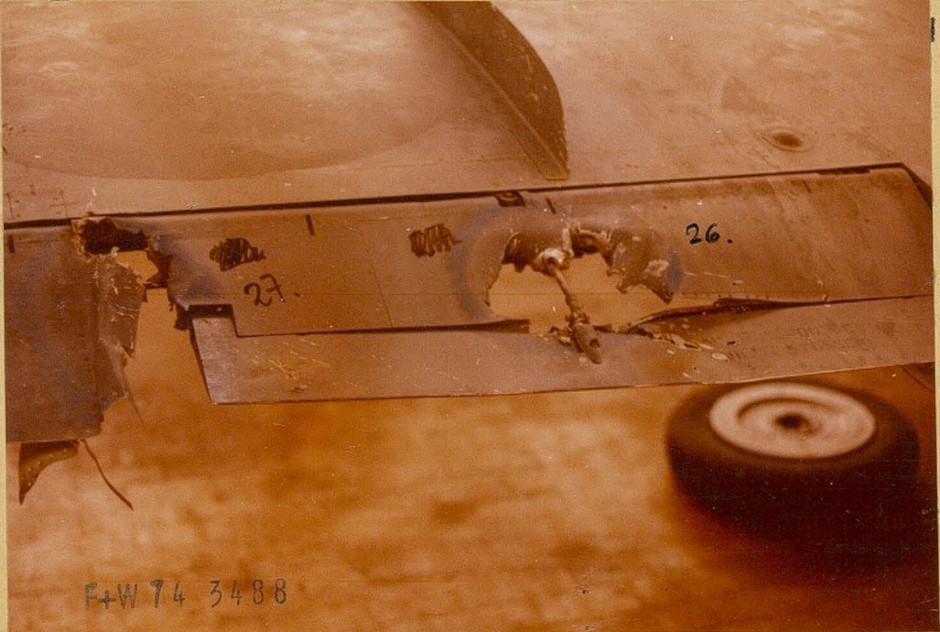
Damage to the flaps from 20 mm rounds
Source: SHE Beschussversuche (Flugzeug - Flugzeug), Bericht über Kanonenschiessen mit Mirage und Hunter auf Pzj G 13, Hongrin 23./24.9.75, Swiss Federal Archives, E4#1000/781#6*, ref. 2.1, BG vom 23.12.1908 betr. die Organisation des EDI, 1908–1909
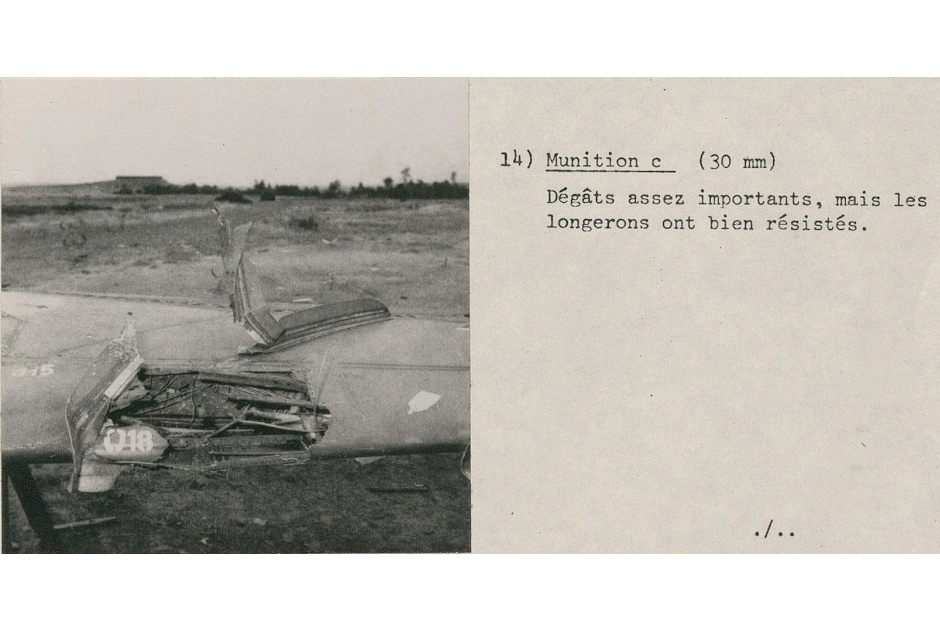
Damage to longerons
Source: SHE Beschussversuche (Flugzeug - Flugzeug), PROTOCOLE No. 35, Swiss Federal Archives, E4#1000/781#6*, ref. 2.1, BG vom 23.12.1908 betr. die Organisation des EDI, 1908–1909
This is the conclusion that we’ve come to: in reality, an aircraft’s structural elements, such as spars, the center wing section, and ribs sustain damage extremely rarely. Small fragments weighing around three grams are simply incapable of compromising the structural integrity of the airframe. Blast damage from external explosions also proved negligible; even high blast-wave pressure on the wing rarely resulted in critical damage.
More than 60% of losses in actual combat were caused by fires in the fuel and oil systems rather than structural failure. Many instances of damage did not result in the immediate loss of the aircraft, but merely forced the pilot to abort the mission and make an emergency landing within 30 minutes, or even up to two hours. Survivability depends heavily on the thickness and material of the skin. Plus, the largest bombers feature a wing box structure in which the upper and lower skin panels also serve as load-bearing elements; these panels are significantly thicker than the skin of conventional spar-based wings, reaching thicknesses of tens of millimeters in certain parts of the structure. Generally speaking, with increase in aircraft speed, the structural integrity and the thickness of the skin also increases. This will also be reflected in the game for aircraft of different time periods.
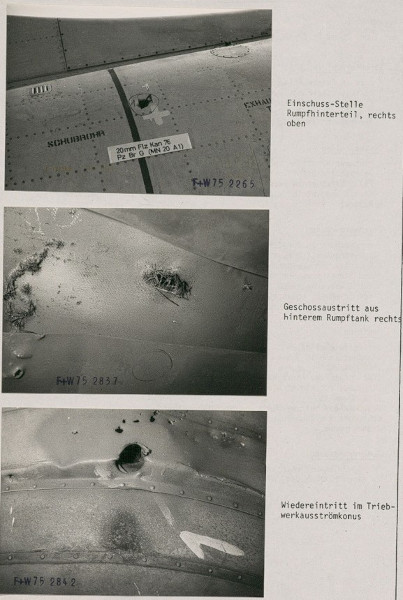
Damage from 20 mm AP rounds
Source: SHE Beschussversuche (Flugzeug - Flugzeug), Bericht über Kanonenschiessen mit Mirage und Hunter auf Pzj G 13, Hongrin 23./24.9.75, Swiss Federal Archives, E4#1000/781#6*, ref. 2.1, BG vom 23.12.1908 betr. die Organisation des EDI, 1908–1909
Conclusion from our research
Based on our research, we’ve completely overhauled the damage model for bombers. We’ve fixed accumulated errors, adjusted damage accumulation parameters, recalculated hit zones, and updated settings for wing spars, tail assemblies, fuselages, and engines. We’ve adopted a flexible approach: for piston-engined aircraft, we created distinct configurations for inline and radial engines, as well as for varying engine counts ranging from two to six. We also separately tuned jet bombers, which require a different damage calculation logic. Alongside the bombers, we updated the damage models for other aircraft classes derived from bomber airframes, specifically the A-26 Invader and Pe-3 families, the Su-8, Tu-1, and TIS-MA attack aircraft, and the Ju 388 J interceptor.
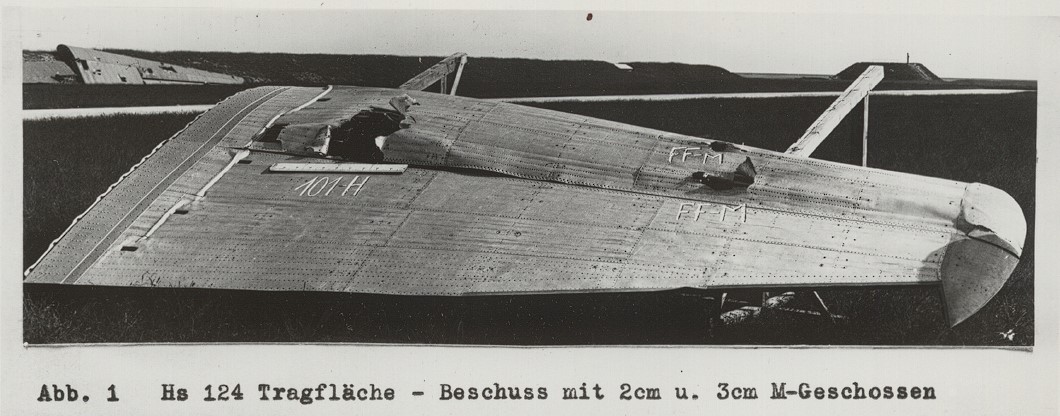
Damage from 20 mm and 30 mm high-explosive incendiary rounds (minengeschoß)
Source: BArch, RL_3_1900 Passiven Flugzeug-Schutz. Vorträge. Bd. 1
The bottom line is, even though we’ve only just begun implementing our findings regarding the survivability of aircraft components against various types of projectiles, bombers have become noticeably more resilient. The enemy can still shoot you down of course, but doing so now requires greater effort and more precise aim. Shearing off wings is now significantly harder, instead you should aim accurately at fuel tanks, engines and the crew itself, which is precisely the targets that pilots were advised to aim for in real life. The type of shell or bullet now play a more crucial role as well.
We’ll continue to refine and improve the damage model, rest assured we’re just getting started and have a long road ahead. But we believe we’ll see more bombers taking to the skies of War Thunder!


Comments (150)
Comments will be premoderatedwell done, finally, now please restore also their role like destroying the enemy Airfield, or strategic target to bomb that cause the enemy to lose like 10%- 15% of the ticket maybe, to give them a role, a reason to use it, people don't use it in air realistic because there is no way to win a battle with it except if you use it in defensive and use your gunner to kill the planes that's attack you, but that's don't have any sense
YIPPIE, now u should give bombers something to do in air rb
Finnaly some good news for bomber pilots
putting the fortress back into flying fortress
Are there any plans to make AI gunners work again? At the moment, increasing the health of the modules is just punishing the bomber interceptor who has successfully maneuvered his plane and landed critical hits.
The best idea is to use manual aim.
been playing since 2013 so I remember the old problems with bombers. My hope is that bombers will be survivable, but won't get such high spawns so that fighters have the ability to easily catch up to and overtake the bombers. but shooting the bombers down will be the challenge, instead of actually getting to them. That would be more fun than the current meta where bombers die easily and a passive bomber takes forever to catch, or the old meta where bombers were powerful and took forever to catch
Finally i can fly without take a single shoot to get down... After 9 years...
Glad to see more realism back in the game - playing bombers needs a careful and strategic approach on a map, since you usually don't get fighter cover or even other bombers to form a defensive formation, so this will help to make it more bearable!
These are the kind of changes the community loves to see. We appreciate you listening to us and thoroughly researching the change before implementation like you have here. Long live bomber gameplay!
Holy Smokes
Submit a complaint