- PC
- MAC
- Linux
- 운영체제: Windows 10 (64 bit)
- 프로세서: 2.2 GHz 듀얼코어 이상
- 메모리: 4GB
- 그래픽 카드: DirectX 11 이상을 지원하는 AMD Radeon 77XX / NVIDIA GeForce GT 660. 최소 사양 해상도: 720p
- 네트워크: 브로드밴드 인터넷
- 여유 저장 공간: 22.1 GB (최소 클라이언트)
- 운영체제: Windows 10/11 (64 bit)
- 프로세서: Intel Core i5 또는 Ryzen 5 3600 이상
- 메모리: 16 GB 이상
- 그래픽 카드: DirectX 11 이상을 지원하는 Nvidia GeForce 1060, 또는 AMD RX 570 혹은 그 이상
- 네트워크: 브로드밴드 인터넷
- 여유 저장 공간: 62.2 GB (전체 클라이언트)
- 운영체제: Mac OS Big Sur 11.0
- 프로세서: 최소 2.2 GHz의 Core i5 (Intel Xeon 은 지원하지 않습니다)
- 메모리: 6 GB
- 그래픽 카드: Metal 을 지원하는 Intel Iris Pro 5200 (Mac), 혹은 이와 비슷한 성능을 가지는 Mac 버전의 AMD/Nvidia. 최소 해상도: 720p
- 네트워크: 브로드밴드 인터넷
- 여유 저장 공간: 22.1 GB (최소 클라이언트)
- 운영체제: Mac OS Big Sur 11.0
- 프로세서: Core i7 (Intel Xeon 은 지원하지 않습니다)
- 메모리: 8 GB
- 그래픽 카드: Metal을 지원하는 Radeon Vega II 이상
- 네트워크: 브로드밴드 인터넷
- 여유 저장 공간: 62.2 GB (전체 클라이언트)
- 운영체제: 64bit Linux 중 최신 버전
- 프로세서: 2.4 GHz 듀얼코어
- 메모리: 4 GB
- 그래픽 카드: Vulkan 을 지원하고, 최신 그래픽 드라이버를 지원하는 NVIDIA 660 (6개월 미만) 혹은 그와 동급의 성능을 가지며 최신 그래픽 드라이버를 지원하는 AMD (6개월 미만; 최소사양 지원 해상도 720p)
- 네트워크: 브로드밴드 인터넷
- 여유 저장 공간: 22.1 GB (최소 클라이언트)
- 운영체제: Ubuntu 20.04 64bit
- 프로세서: Intel Core i7
- 메모리: 16 GB
- 그래픽 카드: Vulkan 을 지원하고, 최신 그래픽 드라이버를 지원하는 NVIDIA 1060 (6개월 미만) 혹은 그와 동급의 성능을 가지며 최신 그래픽 드라이버를 지원하는 AMD RX 570 (6개월 미만; 최소사양 지원 해상도 720p) 이상
- 네트워크: 브로드밴드 인터넷
- 여유 저장 공간: 62.2 GB (전체 클라이언트)

The La-7 in War Thunder
 |
|
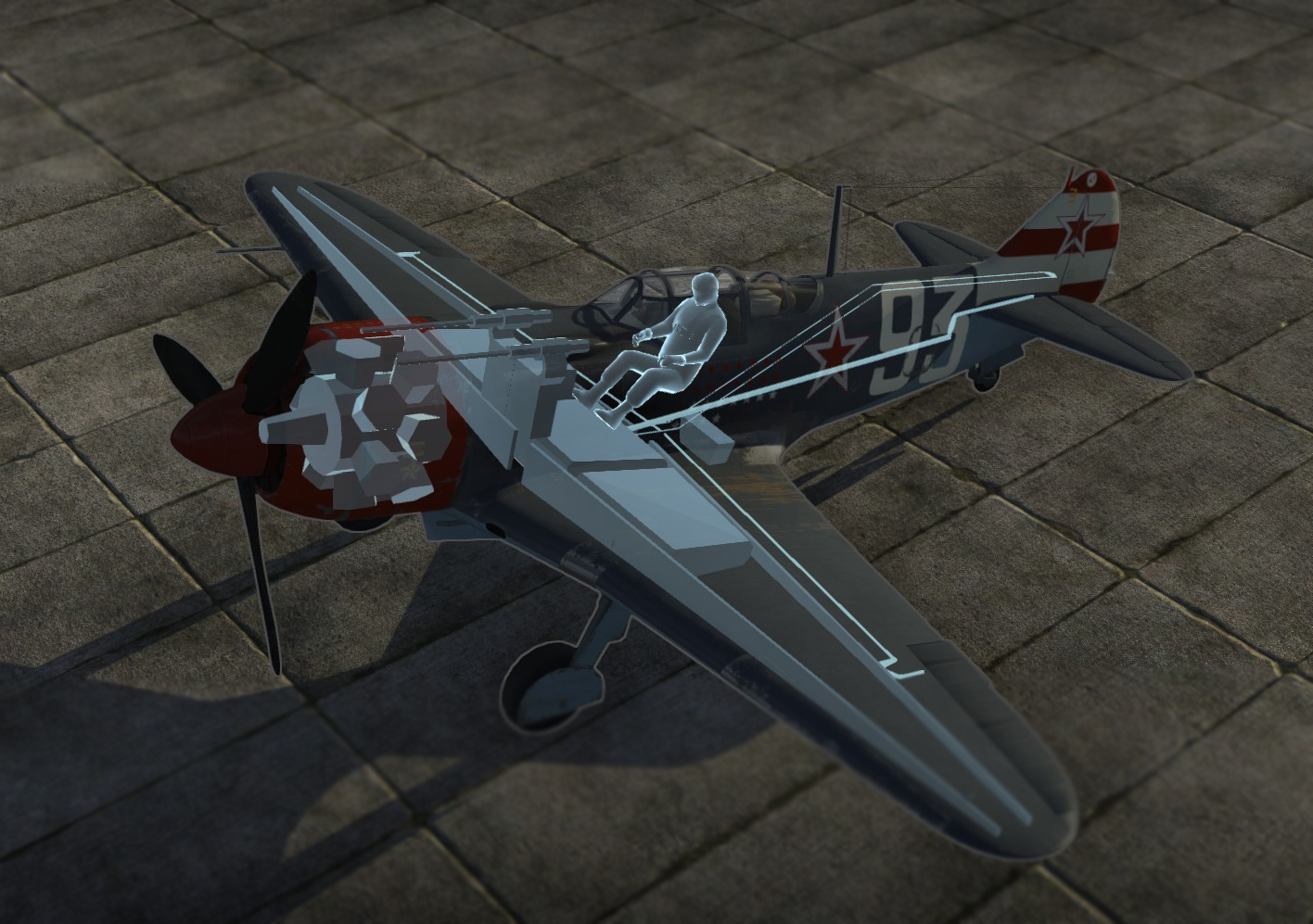
An X-ray view of the La-7 |
In War Thunder, the La-7 is one of the main Soviet fighters of Era IV. In game, it is available in two versions, differing in armament - the regular La-7 armed with 2 ShVAK 20mm cannons, and the upgraded La-7B-20, armed with 3 Berezin B-20S 20mm cannons. Both aircraft are placed quite low in the Battle Rating spread, which means that you will still engage Era III aircraft. The strengths of both La-7 variants lie in very good low altitude performance - ideally, you want to engage your enemies at altitudes lower than 5 km - higher up, the power output of the engine reduces drastically, making you an easy target. Aside from the speed, the La-7 possesses very good turning capabilities - while it is not as good a turner as some British and Japanese designs, it can give many German and US aircraft a run for their money.
The key to staying alive in the La-7 lies in deceiving the enemy. By flying at around 4.5km altitude you present yourself as an easy target for Boom&Zoom aircraft that are flying at higher altitudes. When you spot someone diving at you, break off and evade his burst, while slowly luring him into maneuver combat - this way you will start gaining the edge while the enemy loses his speed and momentum in the turn. Another habit worth developing in the La-7 is ammo conservation - because the available weaponry has a very low ammo capacity, it is crucial to only take shots that you know will hit and aiming them carefully. This way you stand a bigger chance of critically damaging the enemy airplane. By following those rules you will soon find yourself researching the final Lavochkin piston fighter - the La-9.
The La-7 in History
 |
|
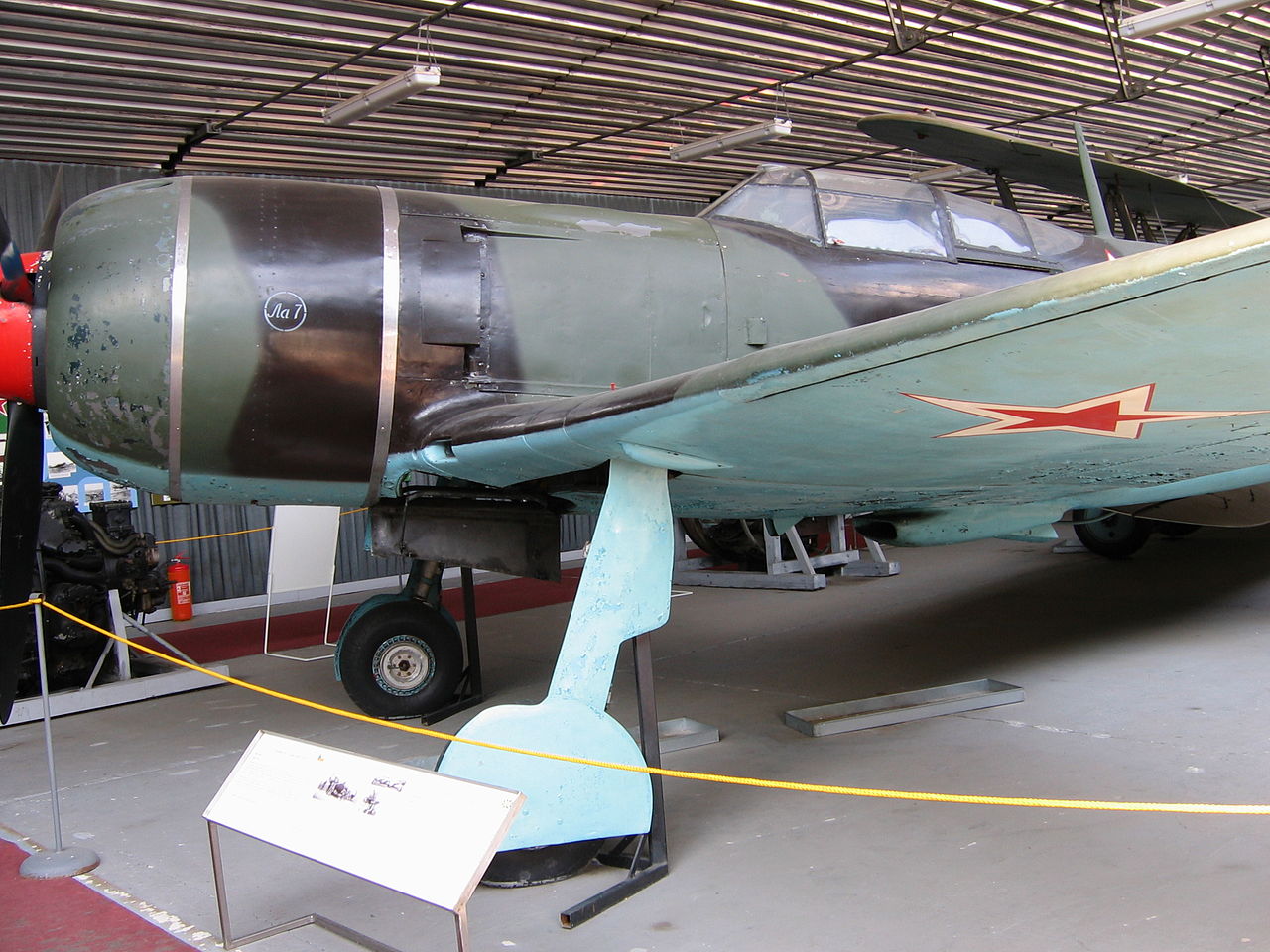
La-7 of the Czechoslovak Air Force, at the Prague Aviation Museum, Kbely |
The concept of a new fighter for the Soviet Air Force was pitched in 1943. While the earlier Lavochkin La-5 proved to be one of the best Soviet fighters produced up to that point, the main designer of the La-5, Semyon Lavochkin, felt that it could be improved even further. Work on a completely new fighter began in the early months of 1944. The new fighter was supposed to be an improved version of the La-5 design. The changes included the incorporation of a lighter and more durable metal airframe in place of the earlier wooden one. Other changes included the mounting of a new gunsight and propeller, as well as the strengthening of the landing gear struts and streamlining of the wings. It was to be armed with three Berezin B-20 20mm cannons, however the delay in production meant that most new La-7s were armed with 2 20mm ShVAK cannons, like its predecessor. After more tests, the new fighter was accepted into serial production in late 1944.
In September 1944, the first La-7s found their way onto the front lines with the 63rd Guard Fighter Aviation Corps. The reception of the new fighter was warm - it was faster and more maneuverable than the La-5, which meant it could more efficiently tackle the most common German fighter the Soviets faced: the Messerschmitt Bf109G. In certain circumstances, the speed allowed the Soviet pilots to intercept Fw190 fighter-bombers - a feat impossible to achieve for other Soviet fighters like the Yak-3. The main critiques of the design were considered to be the engine reliability and armament - the twin 20mm ShVAK cannons were judged as inadequate in fights against better armoured Fw190s. Still, the La-7 became one of the most successful Soviet piston fighters of World War II. Soviet ace Ivan Kozhedub scored 17 kills while flying the La-7 - his last one being an Me262 jet. After the war the La-7 was replaced by the La-9 prop fighter, although many were still used by other communist states as both fighters and trainer aircraft.
Author: Adam “BONKERS” Lisiewicz
In one of the following Updates, we will include
decal from the 9. GVIAP Alelyukhin fighter regiment:

Tell us about your experiences while flying
the Lavochkin La-7 in the comments!
The War Thunder Team